Romeo & Juliet go grunge in Surrey school production
Published 9:00 pm Thursday, March 5, 2026





Sometimes the test of creativity in theatre is not what goes according to plan – but what happens when plans go awry.
The ever-ambitious Southridge Senior School Theatre Company – which years ago outgrew the school’s multi-purpose assembly space in the school’s Grand Hall – was planning to rent White Rock Players Club’s Oceana PARC Playhouse again for its spring production of Romeo and Juliet.
The theatre had worked well for the company’s first foray into devised theatre, The Yellow Suitcase, last March. It seemed like it would be a good fit for the new production, a free adaptation of Shakespeare’s play by drama teacher Sara MacGregor (utilizing Canadian actor Rodger Barton’s edited version from his Shakespeare Outloud Series), and set in a generic Canadian high school in 1994.
“And then we found out the Oceana PARC Playhouse wasn’t available for when we wanted – so we had to pivot,” MacGregor said, interviewed a day before the Feb. 26 ‘soft’ opening of the play (which concluded its short run on Sunday, March 1).
The conventional thought would have been to try to find some way to fit the production into Southridge School.
“It wouldn’t have worked,” MacGregor said.
“There just would have been no room for us there.”
Instead her thoughts turned to the spacious grounds and retro ambience of Alexandra Neighbourhood House (or Alex House, as it is more commonly known) in Crescent Beach – where her daughter used to attend daycare – as a potential venue.
“We thought, let’s do something immersive,” said MacGregor – referring to a school of theatre that utilizes an existing location, setting scenes in appropriate areas, and moving audiences from place to place following the action of the play.
MacGregor and fellow drama teacher Jen Sneller (also co-director and design lead) had often discussed trying an immersive production, Sneller relating to Peace Arch News that she had been fascinated by Sleep No More, an immersive theatre experience she saw at New York’s McKittrick Hotel.
Fortunately Alex House staff were open to the idea of providing a venue and willing to make it work – the first time, as far as anyone can recall, that anything like this has been attempted there.
And thus the former Camp Alexandra was home to a magical theatrical experience last week, helped by a large and impressively conscientious production crew, starting from the instant greeters ushered playgoers into the world of the Capulets and Montagues with a friendly “welcome to 1994.”
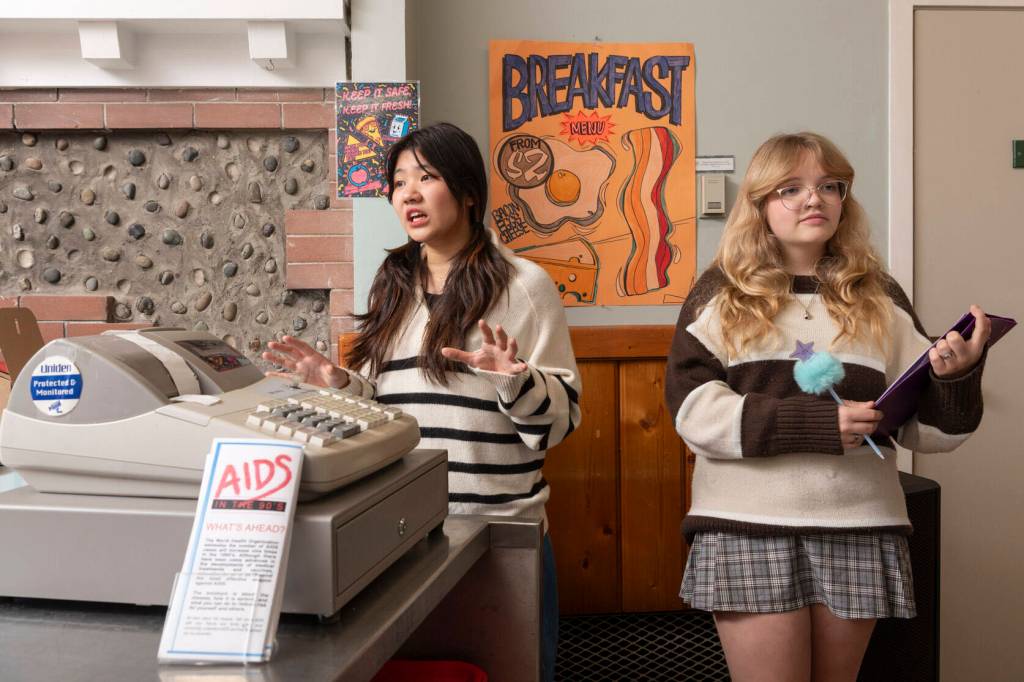
From there, audience members (maximum capacity 65, according to Grade 12 student Akshay Mohan, acting the role of Juliet’s suitor, Paris, while also capably serving as assistant director and mentor of a junior stage management team) were directed to the dining hall, transformed for the play into a high school cafeteria decorated for Halloween.
Forget the fourth wall. Attendees – on the night I saw it, they were largely school students and staff – were allowed to choose their level of interaction with the play, those willing to be part of the action equipped with glow-sticks, masks or costume pieces to match the Halloween theme.
In the “cafeteria,” the logic of MacGregor’s adaptation came into focus.
As McGregor had noted, she was inspired by a number of things that happened in 1994 – including the overdose death of Kurt Cobain, a rise in youth violence and the clash of subcultures in fashion and music (grunge vs. house), and the pressure-cooker atmosphere of high school society in general, to bring a new and vivid volatility to the classic tale of star-crossed lovers.
The banal familiarity of the cafeteria, the AIDS information posters and school public address system announcements, lulled the audience into feelings of nostalgia that soon gave way to the emergence of palpable tensions between two rival “family” factions and inevitably a fight involving knives and lunch trays.
It all seemed disturbingly realistic and relatable for both students and older cast and audience members who recalled the ‘90s ambience well, while another level of realism was reached when real-life Southridge Senior principal Laura Holland intervened (in an impressive dramatic turn) as the principal of Verona High.
Holland was one of several Southridge staff encouraged by MacGregor into adult roles in the play, including Sneller, clearly relishing her role as Juliet’s mother, the villainous, domineering Lady Capulet, and Suzy Baranszky-Job as Lady Montague, confused by her lovesick son Romeo’s evident withdrawal from his peers after a failed romance – another instantly relatable situation.
MacGregor said she was adamant about wanting to cast adults in several parts to underline the youth and lack of life-experience of the main characters.
“It’s cool that we can have adults playing adults – it wouldn’t work nearly as well with teenagers playing the adult roles, which is what usually happens in school productions.”
Introduced to Romeo (Izzy Rayan) and his cousin Benvolio (Jillian Hodson), the audience was efficiently moved on to the next setting (great scene-bridging work in narration and crowd control throughout the play by ‘student council reps’ Serena Parsons and Darla Liu) as Romeo was encouraged to crash the masked ball at the Capulet mansion (staged in Alexandra Hall) by his friends – particularly the wry and fanciful Malvolio (Finley Gray).
Then it was into the disco-lit mansion itself, dominated by Grade 12 art student Derek Yuan’s huge and arresting portrait of Juliet (Aleksandra Dolecki) and her mother, Lady Capulet (in MacGregor’s version, both Romeo and Juliet’s parents were divorced single mothers and clan matriarchs), while a large screen showed Much Music videos and the sound system blasted songs like The Sign by Ace of Base.
After audience members got into dancing the Macarena with actors portraying Capulet partygoers, the show segued back into the narrative smoothly as Lady Capulet bade all to enjoy themselves, while unsubtly engineering proximity of Juliet and Paris, a socially advantageous potential mate for somewhere down the line.
They also viewed, in close proximity, Romeo’s first sight of Juliet – and the instant attraction between them on the dance floor.
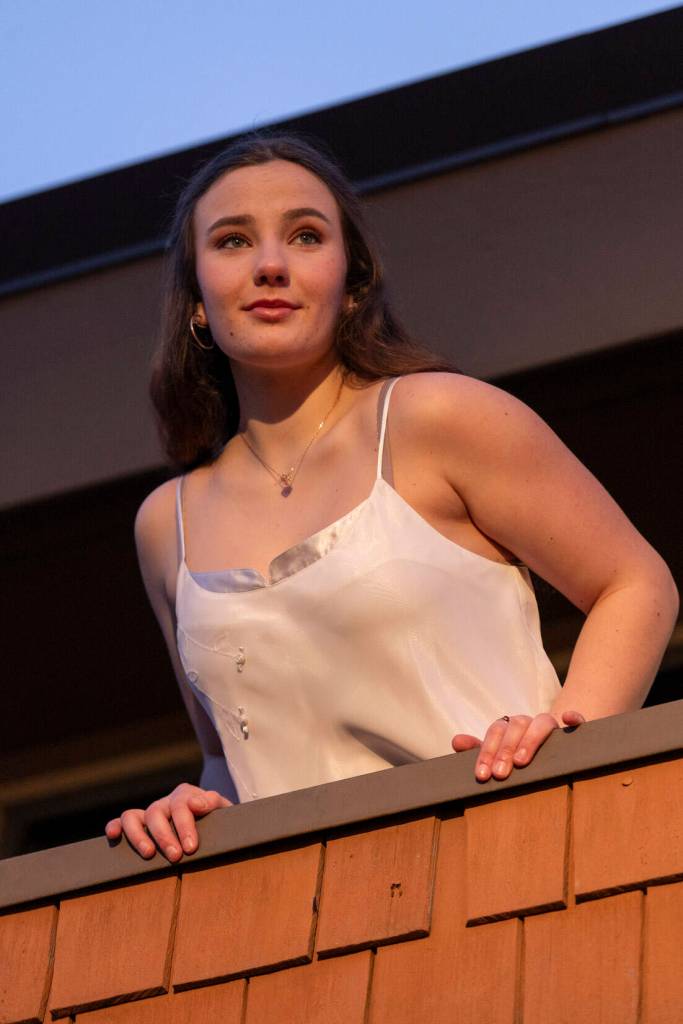
Following the action outside they saw the famous balcony scene – played for once from a real balcony, on the second floor of Alexandra House’s administrative building – essentially eavesdropping as the tragic romance developed in real time.
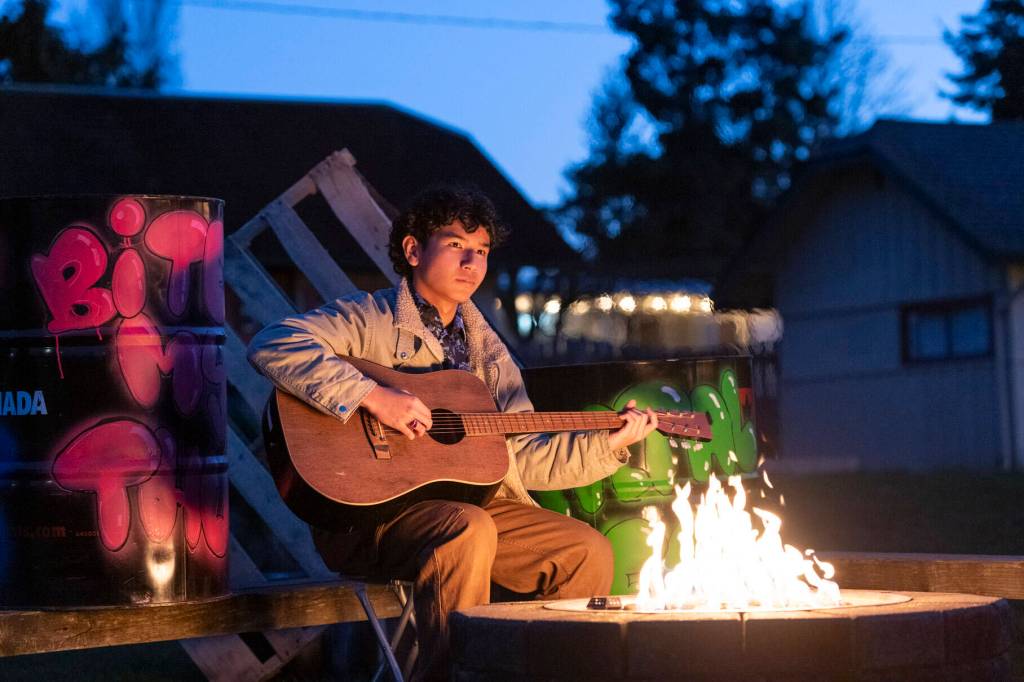
As the plot turned deadly serious leading to Romeo’s banishment to Mantua – represented in the play by a collection of colourfully graffitied oil barrels and wooden pallets around Alex House’s fire-pit, with flickering flames presenting a focal point against the deepening darkness of the evening – the audience continued to follow each tragic twist of the plot with a heightened immediacy.
It was around the fire pit, too, that Romeo reprised Nirvana’s Something In The Way to his own guitar accompaniment, following up the lovers’ romantic theme first heard on Juliet’s era-accurate cassette player – part of the important role that both live and recorded music played in MacGregor’s concept.
All of the Southridge players (including Rachel Yang’s as Juliet’s best friend, Natalie, a more modern version of Juliet’s ‘Nurse’ in the original) clearly acquitted themselves well as actors, dealing with changing locations and challenges of projecting in different environments like seasoned veterans.
But this Romeo and Juliet was fortunate indeed to have Rayan and Dolecki as the leads. Their considerable acting talents also had the benefit of their own youthful freshness and sincerity, bringing a singularly affecting quality to the often-played roles.
“There is a preconcenception of Romeo that he is someone who’s shallow to an extent,” Rayan told Peace Arch News in a pre-show interview. “That’s a lot to do with him going straight from mourning his love for Rosalind to declaring his love for Juliet.”
But Rayan suggested it is also a part of Shakespeare’s depiction of Romeo’s youth and lack of life experience.
“Romeo has depths that people often fail to see in him. I also shared the same preconceptions, but, through playing the character, it’s given me a new perspective on him.”
Having the show set in a ’90s high school ambience brought new dimension to Romeo and Juliet, he said.
“It really plays into the childlike naivete of their love for each other.”
“Juliet wasn’t ever a role I pictured myself in,” said Dolecki.
“I’ve often been cast in shows at Southridge as characters who are a little more powerful – Miss Prism in The Importance of Being Earnest and Regina George in Mean Girls. Compared with them, Juliet is more soft-spoken, but I’ve learned through playing her that she is powerful, too, but in a delicate way. It’s been fun going past what society has accepted Juliet is.”
As lead costume designer for the show, Dolecki agreed that theatre costuming is a function of character, not simply a matter of finding clothes that fit or are in the right era.
“I don’t think I fully connected with Juliet until I found the right dress for her – you have to be as comfortable and confident in what you’re wearing as in what the character says and does.”
While the cast of Romeo and Juliet was quite small compared with some other Southridge productions, many of the actors also had similar off-stage responsibilities, and a large crew of students and teachers all played an important part in ensuring that people and props were in the right place and that everyone could be seen and heard.
But MacGregor gave special credit to teacher Alex Self as technical director.
Self, whose has an extensive background is in technical work for theatre in London, England, was of “immeasurable support” in making the prodction work, MacGregor said.
“In London, I tended to play a very small part in productions,” Self said.
“But I can say that working with these students is the most rewarding thing I’ve ever done.”